
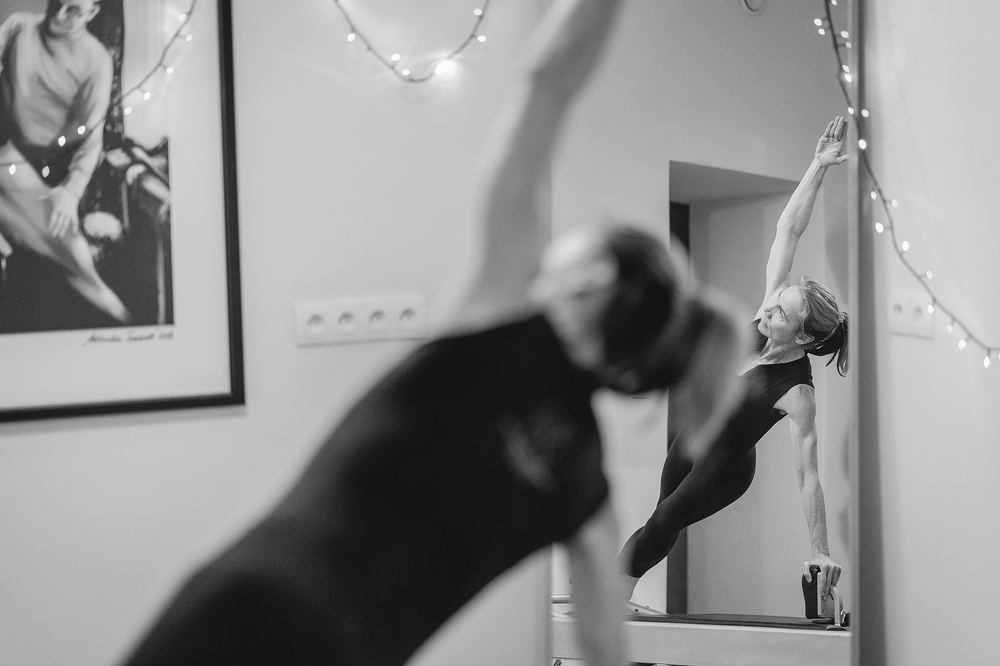
Through perimenopause and after, falling oestrogen changes the terrain: muscle mass declines faster, bones lose density, sleep gets lighter, and the body holds stress differently. None of this is a verdict. It is a brief for the right kind of training — and it is why Pilates keeps appearing in every serious discussion of movement after forty.
Spring resistance is strength training without the jarring: it loads muscle and bone progressively while the apparatus supports your joints and your back. The work strengthens the deep core and pelvic floor, trains balance — the quiet skill that protects you for decades — and its slow, breathing-led control calms a nervous system that midlife keeps switching on.
And because classical work is taught individually — springs set to your body, exercises chosen for your day — it meets you where the month actually finds you. Some sessions build; some restore. Both count.
Our lead instructor Jacqueline Martin has guided women through this exact chapter for two decades. She has served as the resident movement expert of a menopause support community of more than 80,000 women, and her classical teaching has been featured in Vogue and Balanced Body. This is not a class theme for us. It is a specialisation.
If you are managing osteoporosis, surgery, or any medical condition, talk to your doctor first — then tell us, and we build around it. Begin with a private session so we can learn your body, or join a beginner-friendly small group. The method does not ask you to be ready. It asks you to arrive.
See times on the schedule, or read more about Jacqueline.
Free weights load your joints hardest exactly where control is weakest — at the end of the range. Springs do the opposite: resistance builds through the middle of the movement and eases where you are most vulnerable, so you can strengthen honestly without bracing or strain.
For a body renegotiating its hormones, that difference matters. Spring work lets you train hard enough to signal muscle and bone — without the joint wear that sends so many women straight back to the sofa.
After forty, strength is not aesthetic; it is infrastructure. Muscle protects joints and metabolism. Load tells bone to stay dense. And balance — trained deliberately — is what keeps one bad step from turning into a very different decade.
Classical Pilates trains all three inside the same hour: spring resistance for muscle and bone, constant midline work for balance, and a teacher watching every single repetition. That is why it fits this chapter of life so precisely.
Week one: you learn the machine and remember how to breathe. Week two: the deep centre starts answering when you call it. Week three: sleep and posture usually shift first — people notice before you tell them. Week four: movements that felt impossible feel merely difficult, and you begin to trust the body again.
None of this is magic. It is load, precision and repetition, applied by hands that have done exactly this for twenty years.
For this chapter of life we recommend beginning with a private intro session rather than jumping into a group. Not as a rule — as sense: an hour of one-to-one assessment lets your teacher see your spine, your joints and your history before choosing what to load and what to leave alone.
From there, many women thrive in duets or our small groups of at most seven — small enough that hands-on correction never stops. What we would steer you away from is anonymous, choreography-led classes where nobody knows your body. This decade deserves better attention than that.